
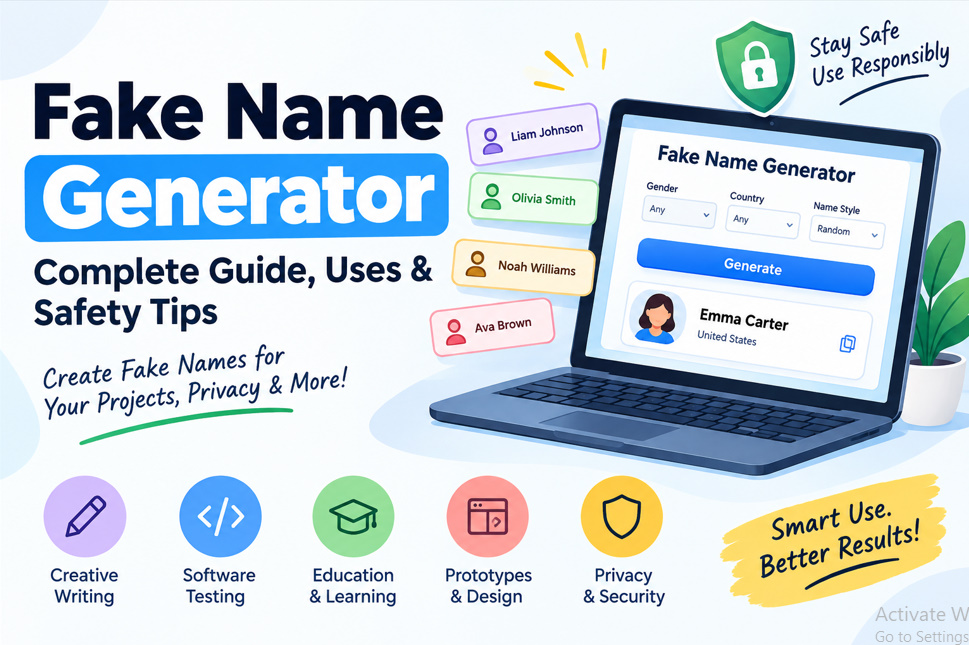
A Fake Name Generator is an online tool that creates fictional names and, in some cases, complete synthetic profiles. Depending on the generator, users may select options such as gender, country, language, region, or naming style before receiving a random result.
These tools can be useful for creative writing, software testing, database development, UI prototypes, educational examples, demonstrations, and synthetic test data. The most important consideration is responsible use: fictional information should remain fictional and should never be used for impersonation, fraud, or bypassing identity verification.
What Is a Fake Name Generator?
A fake name generator automatically creates fictional names by combining information from predefined name collections with randomization methods. A basic tool may generate only a first and last name, while a more advanced fake identity generator can produce additional synthetic fields for testing and development.
The generated information is intended to represent sample or fictional data rather than a verified real identity. Modern generators may support multiple locales, gender preferences, bulk generation, export formats, and repeatable results through seed-based generation, making them useful for both casual and technical applications.
- Creates fictional names
- Generates random combinations
- Supports different locales
- Offers customization options
- Produces synthetic data
- Helps creative projects
- Supports testing workflows
- Saves research time
How Does a Fake Name Generator Work?
A random name generator generally uses a database or collection of first names and surnames. Its algorithm selects elements according to programmed rules and combines them into a complete name. Some tools provide filters that influence which names are selected and how the final result is structured.
More advanced generators can use seed-based randomization, which makes results reproducible. This can be useful for developers who need the same test records repeatedly. Other generators can create multiple names at once, while some provide additional fictional fields such as usernames, email placeholders, or addresses.
- Uses name databases
- Applies randomization
- Combines name components
- Supports filtering
- May use seed values
- Generates multiple results
- Can support bulk data
- Creates instant output
Main Uses of a Fake Name Generator
One of the most common uses is software development and testing. Developers can populate registration forms, databases, dashboards, customer profiles, search interfaces, and prototypes with synthetic names instead of using unnecessary real-person information.
Fake names are also valuable in creative and educational environments. Authors can create character names, game developers can develop fictional personalities, teachers can prepare sample scenarios, and designers can populate mockups. These applications demonstrate why a fake name generator can be more than a simple random-name tool.
- Software testing
- Database seeding
- UI prototypes
- Creative writing
- Character development
- Educational examples
- Product demonstrations
- Sample datasets
Benefits of Using a Fake Name Generator
A major benefit is speed. Instead of searching through long lists of names, users can generate several possibilities almost instantly. This is especially helpful when a project requires dozens or hundreds of fictional records for testing, demonstrations, or creative brainstorming.
Another advantage is flexibility. Users can often generate names based on different preferences, helping them find options appropriate for a particular story, application, region, or project. Synthetic names can also reduce the unnecessary use of real personal information in development and design environments.
- Saves time
- Reduces manual research
- Provides instant ideas
- Supports multiple projects
- Creates sample information
- Helps protect real data
- Improves testing workflows
- Encourages creative exploration
Fake Name Generator for Writers and Creators
Writers can use a fictional name generator to overcome writer’s block and quickly develop character ideas. A generated name can provide the starting point for a protagonist, supporting character, fictional family, business owner, game character, or background personality.
The name does not have to be accepted exactly as generated. Writers can modify spelling, combine elements from different results, or use the output as inspiration. Considering the character’s personality, setting, culture, age, and role can help transform a random result into a convincing fictional identity.
- Create character names
- Develop fictional personas
- Support storytelling
- Generate NPC names
- Build fictional families
- Name imaginary businesses
- Inspire new ideas
- Overcome writer’s block
Fake Name Generator for Developers and Test Data
Developers and QA professionals frequently require synthetic information to test applications before real users interact with them. A fake name generator can provide sample names for registration forms, CRM interfaces, profile pages, tables, search functions, and database records.
Testing with synthetic data can also expose problems involving name length, formatting, sorting, filtering, and responsive layouts. Some advanced generators allow bulk output or formats such as CSV and JSON, making them convenient for test fixtures and development workflows.
- Create test users
- Populate databases
- Test registration
- Check profile layouts
- Test search features
- Test sorting
- Generate sample records
- Support QA testing
Privacy, Safety, and Responsible Use
A fake name can be useful as a placeholder when a real name is unnecessary, but it should not be confused with complete anonymity. Websites and applications can potentially collect other information, including account details, cookies, browser information, device information, or network-related data.
Responsible use means understanding why the fictional information is needed and where it will be used. Generated names are appropriate for legitimate testing, creative work, educational examples, and demonstrations. They should not be used to impersonate individuals, commit fraud, deceive organizations, or circumvent security controls.
- Protect personal information
- Use synthetic data
- Minimize unnecessary details
- Review privacy practices
- Avoid impersonation
- Avoid fraudulent activity
- Follow platform requirements
- Use legitimate purposes
Choosing and Using Generated Names Effectively
Not every generated name will be perfect. When choosing a result, consider its spelling, pronunciation, length, cultural context, and relevance to your project. For creative work, the name should suit the character. For testing, it should help represent realistic input conditions.
It is also important to remember that a randomly generated name may coincidentally match a real person’s name. Random generation does not guarantee uniqueness. If a particular result could cause confusion, generate another option or clearly identify the information as fictional test data.
- Review every result
- Check spelling
- Consider context
- Evaluate pronunciation
- Compare alternatives
- Check name length
- Avoid assuming uniqueness
- Label synthetic information
Frequently Asked Questions About Fake Name Generators
What is a Fake Name Generator?
A Fake Name Generator is a tool that creates fictional names automatically. Depending on the platform, it may generate simple names or broader synthetic profiles for testing and creative purposes.
Is a fake name the same as a fake identity?
Not necessarily. A fake name generally refers to a fictional name, while a fake identity generator may create several synthetic fields, such as a name, username, address, email, or other test information.
Who can benefit from a Fake Name Generator?
Writers, developers, QA testers, designers, students, educators, game creators, and content creators can all benefit from legitimate fictional-name generation.
Can I use generated names for software testing?
Yes. Synthetic names are particularly useful for testing forms, databases, user interfaces, search features, dashboards, and other application components.
Can writers use a Fake Name Generator?
Yes. Writers can use generated names as inspiration for fictional characters, families, businesses, stories, scripts, and games.
Are generated names guaranteed to be unique?
No. A generated name can coincidentally match a real person’s name. Randomization creates possibilities but does not guarantee worldwide uniqueness.
Does a fake name guarantee privacy?
No. A fictional name only replaces one piece of information. Other data may still be collected by websites and online services.
Can a fake name be used to bypass identity verification?
No. If a service requires genuine identity information, users should provide accurate information and follow the service’s verification requirements.
A Fake Name Generator is a versatile tool for creating fictional names and synthetic information. Its value comes from practical applications such as software testing, creative writing, educational projects, prototypes, demonstrations, and brainstorming.
For the best results, choose a generator that provides the options you actually need, review generated results carefully, and treat every output as fictional unless independently verified. Most importantly, use generated information responsibly and never rely on it for impersonation, fraud, deceptive activity, or bypassing identity and security requirements.